Yes, you can make yoghurt from fresh milk in an EasiYo maker. Heat the milk to 85°C, let it cool to about 43°C, stir in 2 tablespoons of plain yoghurt with live cultures, then pour it into the EasiYo jar and keep it warm in the maker for 8 to 12 hours. The one thing to change from the sachet method is the water around the jar. Your milk goes in already warm, so it needs gentler heat than a sachet does.
EasiYo designs its maker around its own sachets and doesn’t publish a fresh-milk method. Its FAQ says the system is designed to take away the hassle of incubating and stabilising milk, and that the milk you need comes in the sachet. So the method below comes from two fermenting suppliers that do cover fresh milk in an EasiYo, Green Living Australia and Country Trading Co, checked against University of Illinois Extension’s tested yoghurt recipe and our own guide to making yoghurt at home. Yoghurt Love isn’t connected with EasiYo.
What You Need
An EasiYo maker and its 1 kg jar, about 1 litre of pasteurised milk (enough to fill the jar to about 5 mm from the top, the level EasiYo uses for its sachets), 2 tablespoons (40 ml) of plain yoghurt with live cultures as your starter, a thermometer, a saucepan, and a hot tap or kettle for the water that goes around the jar.
The Method
1. Heat the milk. Pour the milk into a saucepan and heat it gently, stirring often so it doesn’t catch, until it reaches 85°C. Hold it there for about 10 minutes. The heat changes the milk proteins so the yoghurt sets thicker. Skip it with fresh milk and the result can be thin, grainy or watery.
2. Let it cool to about 43°C. Take the pan off the heat and wait. This is the number that matters most: much hotter than that when the starter goes in and you risk killing the cultures. A sink of cold water around the pan speeds it up. While you wait, fill the empty maker and jar with hot tap water to warm them, then tip it out.
3. Add the starter. Whisk the 2 tablespoons of yoghurt into a cupful of the warm milk until smooth, then stir it gently back through the rest. Pour it into the clean EasiYo jar, to about 5 mm from the top, and screw on the lid.
4. Put warm water around the jar, not boiling. This is where fresh milk differs from a sachet. For a first batch, sit the jar in the maker and pour hot tap water, about 45°C, around it up to the lid. After about 4 hours, tip that water out and pour in fresh hot water. (There’s a second, boiling-water way, compared in the table below.)
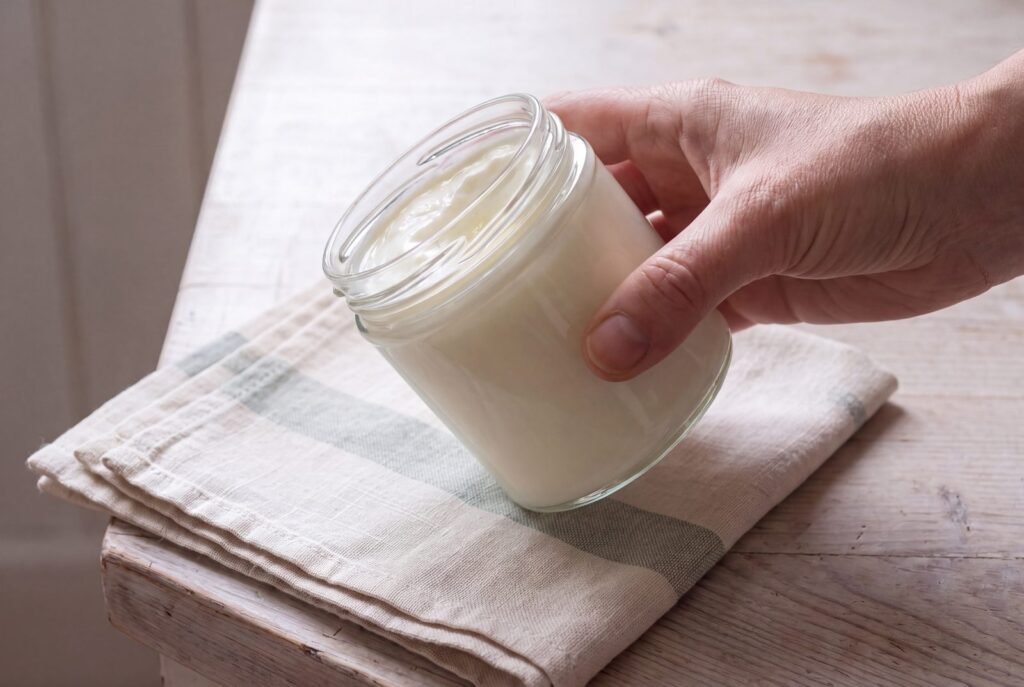
5. Leave it alone for 8 to 12 hours. Close the maker and leave it somewhere it won’t be bumped. From about 8 hours, check it: if you tilt the jar and it holds together rather than sloshing, it’s set. The longer it goes, the tangier it gets.
6. Chill it. Lift the jar out and put it straight in the fridge. It keeps firming up as it chills, so give it a few hours before you judge the texture.
Sachet or Fresh Milk: What Changes
| EasiYo sachet | Fresh milk | |
|---|---|---|
| What goes in the jar | Sachet powder and water at 15 to 20°C | Milk heated to 85°C, then cooled to about 43°C |
| The culture | Already in the sachet | 2 tablespoons of plain yoghurt with live cultures |
| Water around the jar | Boiling, up to the top of the plastic insert | Hot tap water at about 45°C, or boiling water kept below the baffle (see the next table) |
| Time in the maker | 8 to 12 hours | 8 to 12 hours |
| Afterwards | Fridge for a few hours to finish setting | The same |
| How long it keeps | Up to two weeks in the fridge | One to two weeks in the fridge |
Two Ways to Keep It Warm
The two suppliers that cover fresh milk in an EasiYo don’t agree on the water. Both start with milk that’s already warm, about 40 to 45°C.
| Warm water | Boiling water | |
|---|---|---|
| From | Country Trading Co | Green Living Australia |
| The water | Hot tap water, about 45°C. Not boiling. | Boiling |
| How full | Around the jar, up to its lid | Just below the hole in the red baffle, so it never touches the jar |
| Top-ups | Swap for fresh hot water after about 4 hours | Replace as needed to keep the milk between 37 and 43°C |
| Watch for | In a cold kitchen it cools faster, so don’t skip the swap | Too much heat kills the cultures, so keep the water clear of the jar |
Our pick for a first batch is the warm water. EasiYo pairs its boiling water with a jar that starts at 15 to 20°C. Your milk is already at about 43°C when it goes in, so it only needs holding there. It’s also close to the warm-water bath, about 49°C, that University of Illinois Extension suggests for setting yoghurt in an esky. If your batches come out slow or thin in winter, try the boiling-water way.
Choosing Your Milk
Full cream milk gives the thickest, creamiest yoghurt. Skim milk sets thinner and sharper. To firm it up, whisk about a quarter of a cup of skim milk powder into each litre of cold milk before you heat it. UHT (long-life) milk has already been heat-treated, so you can skip the 85°C step: just warm it to about 43°C and carry on from step 3. Whatever you use, make it pasteurised milk, fresh or UHT. For your first few batches, steer clear of lactose-free or ultra-filtered milk, which can set unpredictably.
Troubleshooting
It didn’t set. The usual causes are heat, culture and warmth. The milk may have been too hot when the starter went in, the starter may not have had live cultures, or the water around the jar may have gone cold. Next time, cool the milk to 43°C first, use a fresh plain yoghurt that lists live cultures, and swap the water at 4 hours.
It’s thinner than sachet yoghurt. Some of this is normal for fresh milk. For a firmer set, use full cream milk, hold it at 85°C for the full 10 minutes (up to 20 for extra thick), and chill it properly before eating. Or strain it for Greek-style yoghurt, and keep going for labneh.
It’s too sour. Sourness comes from time. Start checking from 8 hours next time, and get it into the fridge as soon as it has set.
It’s grainy or lumpy. This usually means the milk got too hot, or it was stirred too hard once the starter went in. Heat gently, stir the starter in softly, then leave it alone.
Common Questions
Does EasiYo say you can use fresh milk? Not directly. EasiYo’s FAQ says its system is designed to take away the hassle of incubating and stabilising milk, and that the milk you need comes in the sachet. The fresh-milk method on this page comes from fermenting suppliers, not from EasiYo.
Can I use some of my EasiYo yoghurt as the starter? Yes, if it’s plain. Any plain yoghurt with live cultures works as a starter, including one you made from a sachet. Skip flavoured or sweetened ones, and use it within 5 to 7 days of making it.
Do I need to heat UHT milk? No. UHT milk has already been heat-treated, so just warm it to about 43°C before adding the starter. Fresh milk needs the 85°C step for a thick set.
Can I use boiling water like I do for sachets? Not in the same way. EasiYo pairs boiling water up to the top of the insert with a jar that starts at 15 to 20°C. With warm milk, use hot tap water at about 45°C, or keep boiling water below the hole in the baffle so it never touches the jar.
How long does it keep? One to two weeks in a sealed container in the fridge. It gets a little tangier over that time.
Sources
The fresh-milk method is adapted from Green Living Australia’s yoghurt basics and Country Trading Co’s guide to fresh milk in an EasiYo maker. Temperatures, times and starter amounts are cross-checked against the tested recipe from University of Illinois Extension and our own How to Make Yoghurt at Home. The sachet details and storage times come from EasiYo’s FAQ.